This story was produced by Resource Rural in partnership with Mountain Association.
After Eric Mills became the director of public health for eastern Kentucky’s rural Martin County, he had some numbers to crunch. Resources are scarce in this community, where 53% of children live in poverty.
Electricity costs for the public health building were high, and would likely increase in the coming years. The fleet of vehicles the department used for outreach to new moms was aging and came with a sizable monthly fuel bill. He only had enough funding for a team of eight to run seven public health programs for the county.
When he looked at the numbers, he realized that tax credits, grant funding, and a long-view investment in electric vehicles (EV) could net the department significant savings, allowing it to reinvest in programs and personnel.
“I started looking at the numbers and I thought it could work,” Mills said. He came to the job from the private sector. That non-traditional path helped him approach his work in public health with a fresh perspective. “A lot of people are afraid to try new things but that is the only way I have ever known,” he said.
To combat rising electricity costs, Mills began researching the viability of solar panels for the building. He requested proposals from vendors and soon received a call from the Mountain Association, a nonprofit community economic development organization supporting eastern Kentucky.
With their guidance, Mills tightened up and added more details to his request for proposals, which initiated better bids from vendors. The Mountain Association also secured the department a $50,000 grant to help offset costs.
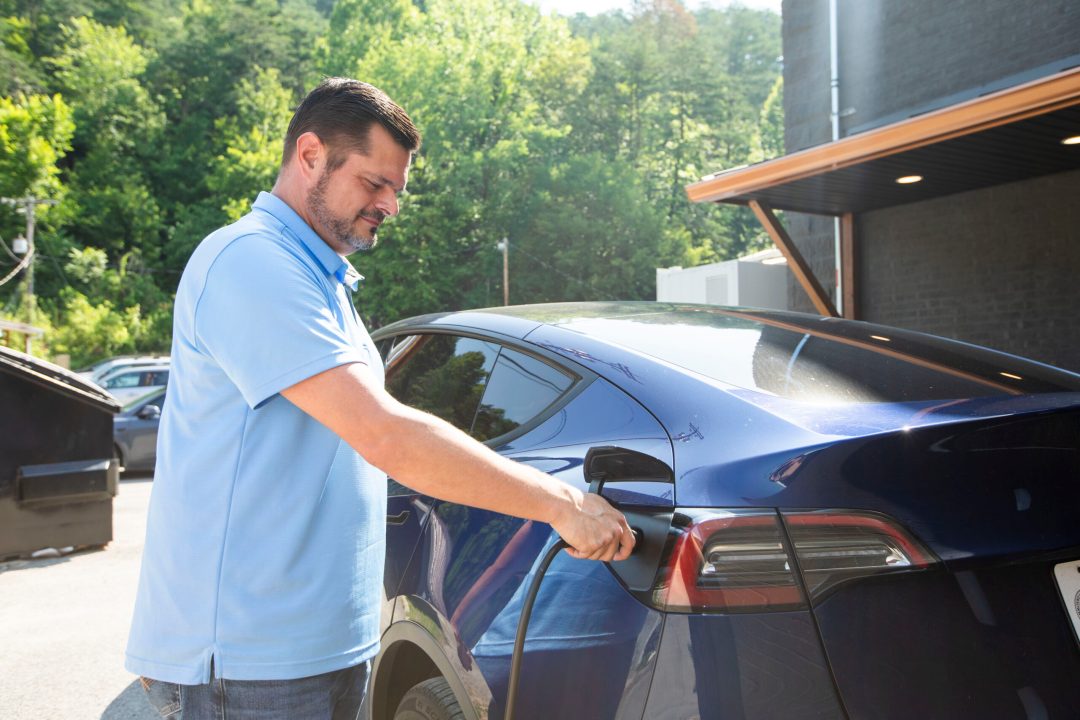
With a solar energy tax credit covering 30% of the installation, and an additional 10% credit for the county’s designation as an “energy community,” Mills figured he had a head start on making the numbers work, even before that grant became available. And if they upgraded their vehicles to electric, he figured they could utilize the solar energy to charge the cars.
“Even paying 60% for solar, it was cheaper for us in the long run at our current rates, knowing they would go up. Our board was very supportive,” he said. “And we felt we could also save more by fueling our cars on solar, too.”
One of the solar installers introduced Mills to the Solar Finance Fund, which received funding from a variety of sources including the U.S. Economic Development Administration. After the Board stepped up with local tax dollars, the fund offered to cover a quarter of the cost, further reducing the department’s portion.

At the same time that Mills was investigating the viability of an EV fleet and solar panels, he learned that the public health department had no source of backup power and could not adequately respond to public health emergencies. To shore up resiliency, he needed to make sure that the solar installation included a battery back-up, which came at no small cost.
“Why on Earth would I put a diesel generator on a building with solar panels?” he asked, rhetorically. “With a battery, we would be able to perpetually have power, full steam, in the event of a disaster. And since I’d never have a chance to have 60% of the cost for a battery paid for again, that’s what we did.”
Projections show that the $492,000 system should pay for itself in just under four years factoring in the support of grants and tax credits. Mills estimates the direct $90,000 local tax investment will bring an overall net savings to the health department of around $30,000 to $32,000 per year, all of which will be reinvested into public health services.
By reducing its electric bill and nearly eliminating a fuel bill, as well as seeking other funding, the department has been able to hire additional staff members and expand services, introducing new programs for diabetes care and prevention, breast cancer awareness and outreach, tobacco cessation, and HIV and family planning education.
“We felt more comfortable making these new program investments because of the energy cost savings. We love our community and have been expanding our programming to better serve our neighbors,” he said, referring to the new registered nurses and administration director he’s been able to hire. “Positions like these have been made possible through better stewardship of funds of which the solar program was absolutely a big part.”
The Inflation Reduction Act (IRA), passed by the 117th Congress and signed by President Biden is a piece of federal legislation that aims to reduce inflation by lowering the cost of prescription medications, investing in domestic energy production, and promoting clean energy, among other objectives.